.webp)

AI adoption isn’t just about choosing the right tools; it’s about preparing your people. That was the central message of our first session in the Future of Learning webinar series: Beyond the Tools: Driving Human-Centered AI Adoption.
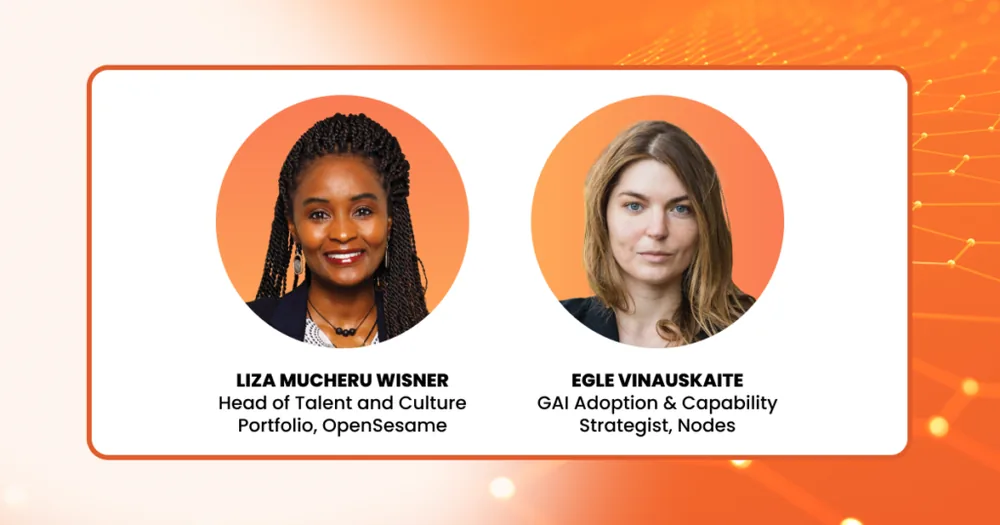
Our guest was Eglė Vinauskaite, named one of HR’s Most Influential Thinkers in 2025. She’s the award-winning director of Nodes, a studio focused on the people side of AI adoption. With a background in learning, behavior, and technology, Eglė has spent the last eight years advising global brands on how to upskill their workforce, drive sustainable change, and prepare for AI at scale.
With that kind of depth — spanning strategy, behavior change, and implementation — Eglė offered a clear-eyed view of why so many AI rollouts stall, and what it really takes to move them forward.
Here are five lessons that stood out and what they mean for your organization:
1. Personal AI use doesn’t always scale to organizational change
AI’s benefits are obvious at an individual level. Employees discover ways to automate repetitive tasks, generate quick drafts, or summarize hefty documents. But, as Eglė explained, what people do in isolation doesn’t automatically translate into enterprise-wide transformation.
“In organizations,” she noted, “the adoption might be quite good in some functions… but when you ask how people use it, a lot of it is essentially writing emails and summarizing documents, which was already possible two years ago.”
Individuals may try new tools on their own, but without alignment to broader strategy, those efforts stay siloed. The challenge for organizations is to turn those scattered personal wins into organization-wide progress by building structures, resources, and programs that connect everyday use to bigger impact.
2. Productivity often dips before it improves
One of the most striking insights from the session was that AI adoption follows a curve: initial excitement, followed by a period of frustration where productivity actually drops.
“Most assume AI adoption looks like this: you give people the tools, you show how to use them… when in reality, it works a bit like this,” Eglė said, pointing to the inevitable dip that comes when people are asked to change established workflows.
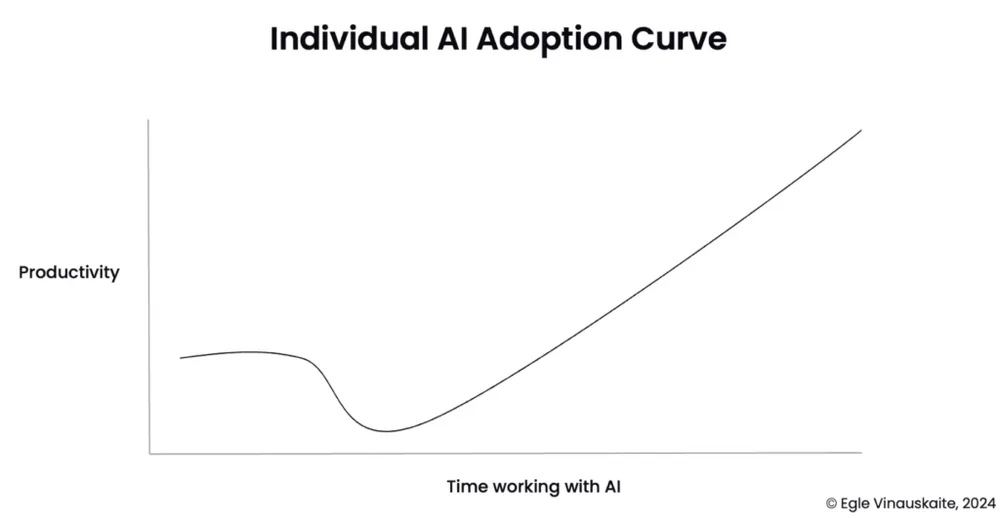
That dip doesn’t mean something’s gone wrong—it just means people are still adjusting. Switching to AI often interrupts familiar habits, takes time to learn, and might even slow things down at first.
Eglė warned that too many organizations “give people just enough to fall into that dip, but not enough to help them out.” The solution? Provide coaching, practice, and reinforcement to help people climb out of the dip rather than abandon AI altogether.
3. Culture and mandate make or break adoption
Tools and training may kickstart AI use, but they don’t guarantee adoption. What really matters is whether culture and mandate align. As Eglė explained, mandate is leadership’s role in setting direction and providing resources, while culture is about whether people feel safe to experiment and innovate.
Her AI Adoption Matrix shows how these two forces combine: with neither, adoption stalls in idle potential; with only culture, it results in scattered casual experiments; with only mandate, it slips into reluctant compliance.
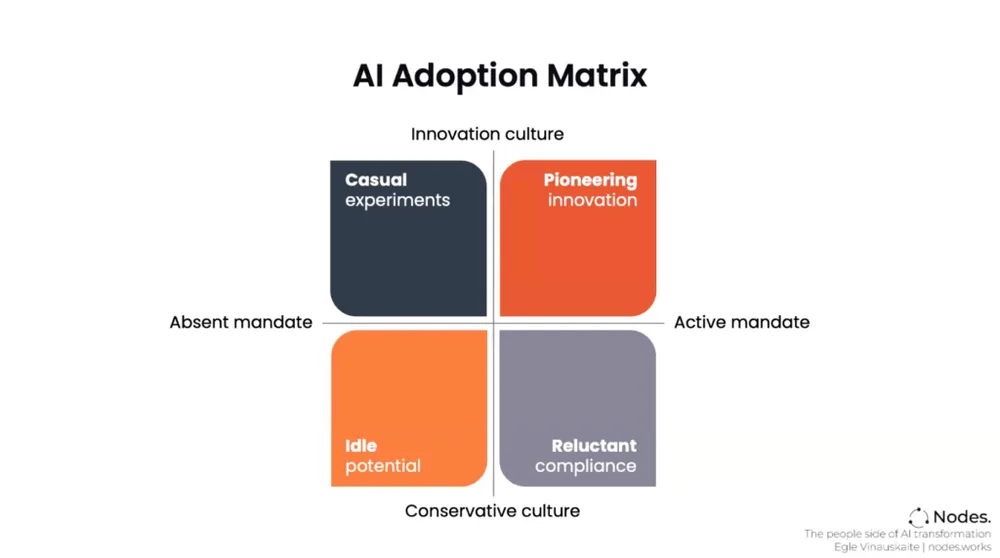
The real goal is the top-right quadrant: pioneering innovation, where leadership support and innovation culture reinforce each other.
“There aren’t very many organizations in that pioneering quadrant,” Eglė reminded us, “so if it’s not you, don’t despair. You’re not behind everyone else.”
The key is to be honest about where your organization sits today and then take clear steps to move closer to that balance of culture and mandate.
4. Training alone won’t drive real adoption
Too often, organizations approach AI adoption as a training initiative: give employees the skills, and productivity will follow. But Eglė urged leaders to think differently.
“Think about AI adoption as a behavior change problem, not as a training problem,” she said. Training may cover the “how” of AI tools, but it doesn’t address the emotions—fear, uncertainty, or indifference—that shape whether people actually use them.
She emphasized that adoption requires communication, trust, and buy-in. Employees want to know how AI will affect their roles and whether they’ll be supported through the transition. To succeed, organizations must go beyond training to design programs that shift habits and mindsets.
5. Empower your champions to lead the way
Finally, Eglė encouraged leaders to look within their organizations for champions already experimenting with AI.
“Harness your power users,” she said. “Your employees, your power users, are your R&D.”
These early adopters are valuable not only for their skills but also for the cultural signal they send: that AI is worth exploring, and that experimentation is encouraged. Rather than relying solely on top-down directives, empowering champions turns adoption into a collective movement that feels relevant across teams and functions.
Ready to go beyond the tools?
These five lessons are just the starting point. In the full webinar, Eglė walked through her Foundation–Activation–Culture framework and offered practical guidance on setting realistic goals, addressing employee concerns, and securing leadership alignment.
Watch the full webinar recording
To help you put these insights into action, we’ve created a step-by-step AI Adoption Change Management Checklist. The checklist turns strategy into action, outlining how to lay a strong foundation, activate adoption across teams, and make AI part of your organization’s culture.
The message is clear: AI adoption is not just a technology project; it’s a people strategy. By investing in culture, behavior, and human-centered practices, organizations can move beyond scattered experiments and build the foundation for lasting, scalable success.