


It started with road trip recommendations.
When Tina Jones, Learning Programs & Talent Development Manager at OpenSesame, first opened ChatGPT, it wasn’t for work, but for fun. She used artificial intelligence (AI) to help her plan a vacation and whip up recipes from random ingredients in her fridge.
But that casual exploration sparked a profound shift in how Tina works.
Today, AI is a staple in her L&D toolkit, acting as her personal teammate, thought partner, and time-saver. And it’s making a real difference: “I can dive deeper into more robust work than I was able to before,” she says.

Meet Tina Jones
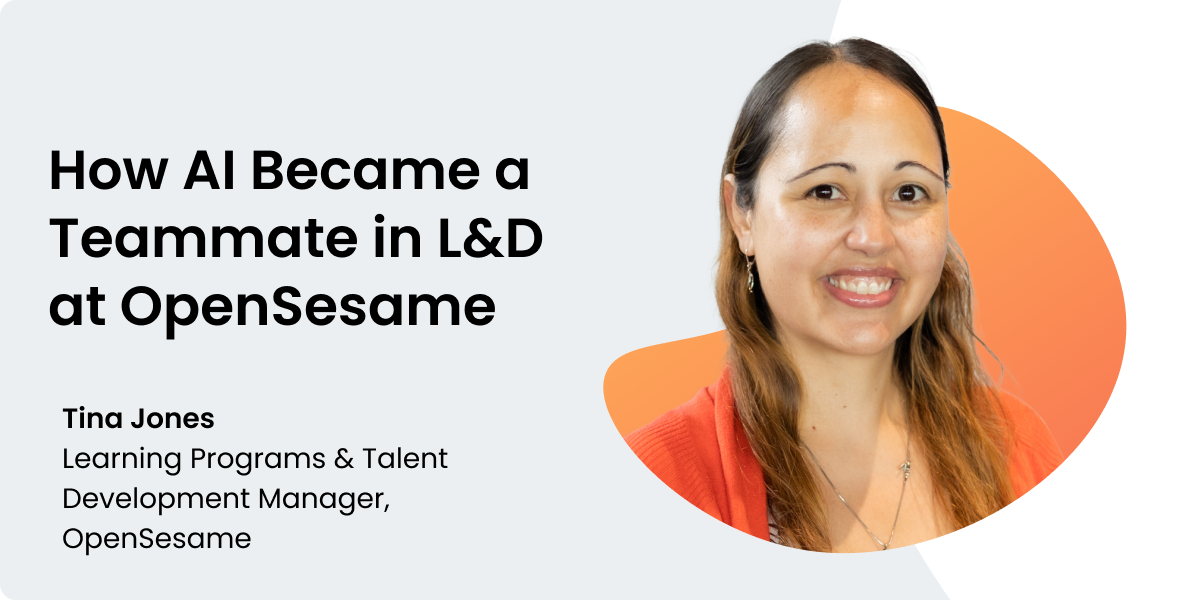
Tina Jones is a Learning & Development leader with over a decade of experience designing scalable programs that drive organizational growth. At OpenSesame, she manages company-wide learning initiatives, leadership development programs, and onboarding experiences that bring the company’s mission, vision, and culture to life from day one.
How AI helps Tina as a team of one
As the sole L&D practitioner at OpenSesame, Tina wears a lot of hats: course designer, facilitator, data analyst, and internal communications lead. But with AI, she no longer has to go it alone.
“I don’t have a sounding board or a thought partner. So I use AI as a teammate, someone I can run ideas across.”
ChatGPT and other embedded AI tools now help Tina:
- Draft clear, polished communications to learners and the full team.
- Generate course outlines and quizzes using Simon.
- Brainstorm and create first drafts to break the blank page barrier.
- Create structure for projects so she can focus on high-value details.
What used to feel overwhelming now feels manageable, even fun.
As Tina puts it, AI helps her “get off the ground at first,” clearing the way so she can focus on the deeper thinking and fine details that really need her attention.
Using AI to connect learning with business outcomes
Like many in L&D, Tina receives plenty of learning data, including course completions, engagement rates, and content usage. But interpreting that data and connecting it to outcomes? That’s another story.
Recently, Tina started using AI as a data partner. She uploads data into ChatGPT and asks it to help her analyze patterns, spot gaps, get a baseline, and even recommend next steps to get comparative data. She says it’s been a game-changer.
“I’ve been having a lot of discussions with GPT on data—understanding what it’s telling me, and then how to communicate that to other folks to continue to promote the return on investment,” Tina says. “It’s helping me change the conversation I’m having with my manager and our leadership team.”
And while AI has become a powerful analytical partner, it’s also helping Tina level up her creativity.
Designing smarter, stickier training with AI
Tina is exploring how AI can help design better learning experiences. Not just faster, but smarter.
One of her recent projects started with a creative twist: What if advertising techniques could make learning more memorable? She fed notes from a webinar into ChatGPT, along with course ideas, and asked it to apply those principles to learning design.
“It gave us some ideas, and then we went back and forth—okay, we like this, we don’t like this, what about this?” Tina says. “It was really an active partner in that.”
The final product? A set of creative, stickier training experiences that wouldn’t have come together without AI in the room.
The future Tina hopes for AI in L&D
Tina sees enormous potential in what’s coming next for AI, especially in helping learners move beyond passive content into active skill development.
Tina sees potential for AI to fill the gap between knowing and doing: “Where e-learning falls short is that it’s always the in-theory place.” She envisions tools where learners roleplay with AI-powered coaches, test their skills in safe scenarios, and receive immediate, personalized feedback, without the pressure of performing in front of peers.
“AI has this protective feature that it’s not a person… there’s no shame or guilt.” That safety, she says, can help people try, fail, and grow, without fear of being judged.
It’s not here yet. But she’s watching closely.
Tina’s advice to other L&D pros
“You can’t avoid it. It’s here to stay. So just start using it in whatever way you can.”
For L&D professionals who feel intimidated by AI, Tina suggests starting with tasks that you’re already doing, such as writing emails or summarizing meeting notes. For those completely new to AI, she recommends integrating it into your personal life first.
“I understand the hurdles that folks have when trying to use it for their professional life, but try and take those away and do it personally, and then start to figure out how you can embed it professionally as well.”
What starts as a simple experiment might become your most reliable work companion. As Tina puts it, “Before you know it, you’re talking to it all the time.”
In a field like L&D, where you’re often expected to do more with less, that kind of support can make all the difference.
Want to get started with AI in your L&D work?
Here are a few OpenSesame tools and resources to explore:
- Create AI-assisted courses with Simon – Skip the blank page and start building quality learning experiences in minutes.
- Try 5 AI prompts for L&D pros – Explore practical, easy-to-use prompts to get started right away.
- Join our upcoming webinar – Donald H. Taylor and Eglė Vinauskaitė share fresh research and unexpected ways AI is transforming L&D.
Tina’s story proves you don’t need to be a tech expert to unlock real value from AI. You just need to start.

About the author
Once an Instagram video editor and Minecraft architect, Sydney now brings her creativity to OpenSesame as a Content Marketing Specialist. She’s known for overthinking LinkedIn copy and applying her knack for editing, this time to words instead of Instagram videos. Outside of work, she’s busy chasing flight deals and happily-ever-afters in her 150+ books a year goal.