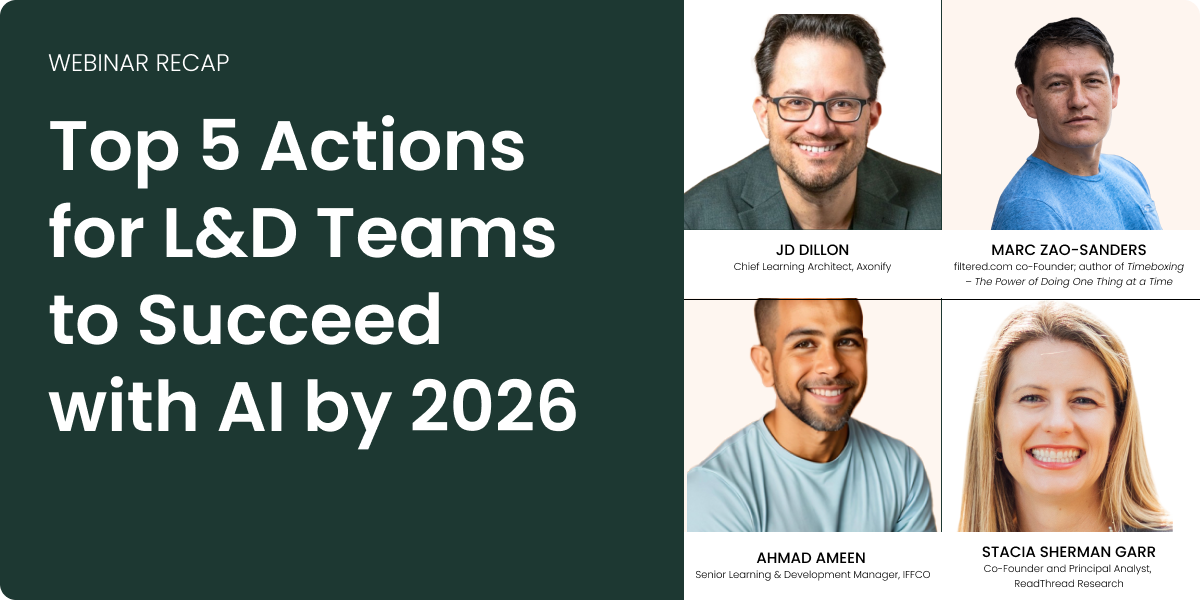
Top 5 Actions for L&D Teams to Succeed with AI by 2026
25 November 2025
By Sydney Ward
AI is changing everything, especially how we learn. But are we ready?
Everyone’s talking about AI, but few are talking about how actually to make it work in the real world. That’s what we set out to explore in the final session of our Future of Learning series: Learning Transformed: AI’s Role in 2026.
Host Liza Mucheru Wisner, OpenSesame’s Talent and Workplace Culture Portfolio Lead, brought her signature energy and human-first lens to the conversation. She was joined by:
JD Dillon, Chief Learning Architect at Axonify and author of The Modern Learning Ecosystem
Stacia Sherman Garr, co-founder and Principal Analyst at RedThread Research, and one of the world’s leading voices on people analytics and HR tech
Marc Zao-Sanders, CEO of Filtered and author of Timeboxing: The Power of Doing One Thing at a Time
Ahmad Ameen, Senior Learning & Development Manager at IFFCO in Dubai, who is driving AI adoption across a global workforce
Together, this panel shared practical ways L&D and HR leaders can navigate the fast-moving world of AI. Based on their conversation, here are five actions to take now to make AI a real driver of progress by 2026.
1. Redefine “learning” as “enablement”
JD Dillon recently changed his title from “Chief Learning Architect” to “Chief Enablement Architect.” Small shift, big meaning. Inside L&D, we can get so focused on tactics and mechanics that we lose sight of what really matters: helping the organization achieve its goals. And outside of L&D, words like “learning” often come with baggage. As JD put it, “the value we provide has to transcend and be bigger than the concept of learning, just like it has to be bigger than the concept of courses.”
By reframing our mission around enablement and using AI as a tool to empower that, L&D can focus on what truly drives impact: helping people perform, adapt, and thrive.
2. Focus on “little AI” before “big AI”
“Little AI is us using ChatGPT to be more efficient in our work as individuals. Big AI is a systematic enterprise implementation of AI. Transitioning from little AI to big AI isn’t easy.”
Stacia Sherman Garr
A now-famous MIT statistic claims that 90% of AI pilots fail. Whether or not that number is exact, the reason it resonated is clear—many organizations see themselves in it. The promise of AI is huge, but turning that promise into progress is where most stumble.
Most teams are great at what Stacia Sherman Garr calls “little AI,” using tools like ChatGPT or Gemini to boost efficiency and creativity. Where they get stuck is trying to leap straight to “big AI,” those enterprise-wide transformations that change entire systems and workflows.
The lesson: don’t rush the revolution. Learn from the wins of “little AI,” start small, and scale what sticks.
3. Build trust before you build tools
To make AI adoption work for your people rather than against them, trust comes first. What’s preventing employees from trusting AI in your organization today?
Start with transparency. Be clear about what data AI uses, where it comes from, and which ethical lines won’t be crossed. Communicate openly about how AI works, set visible guardrails, and give people a voice in how it’s applied. When employees understand where AI comes from and how it can help them do their best work, trust follows — and adoption comes naturally.
Not sure where to begin?
Our Trust-First AI Playbook equips CHROs and CLOs to reduce risk, align their teams, and build transparency into every step of AI adoption, before rolling it out across the enterprise.
4. Make prompting a core skill
What skills will every professional need by 2026? Ahmad Ameen and our curation team agree: prompting – writing clear, targeted instructions that help AI systems like ChatGPT generate accurate, useful results – is becoming as foundational as using Excel or Outlook. It’s the new digital literacy of the workplace.
Looking ahead, Marc Zao-Sanders envisions a world where everyone has an AI assistant that acts as a collaborator. One that helps you sharpen ideas, personalize learning, and think more effectively. At OpenSesame, we’ve seen this in action. Here’s how AI became a teammate in L&D.
Start by enabling your workforce (and yourself!) to use prompting as a bridge to that future, turning AI from a tool you use into a partner that helps you grow.
5. Clean your data before you scale your tech
If there’s one action to take after watching the webinar (or reading this recap), Marc Zao-Sanders wants it to be this: clean your data. AI is only as smart as the information you feed it. L&D teams must clean, tag, and organize their content so AI systems can actually make sense of it and deliver real value.
Marc reminded us that before we can chase the “glamorous” side of AI – personalization, recommendations, analytics – we need a strong foundation. Without quality data, even the most advanced tools produce noise instead of insight.
Start small: audit your existing learning libraries, fix your metadata, and align your systems now.
As we look toward 2026, the leaders who thrive will be those who focus less on the tools themselves and more on the people and systems that bring them to life.
Start small. Stay transparent. Teach new skills. Invest in your data. The organizations that do will be the ones ready for whatever comes next.
Ready to put these actions into practice?Watch the entire Future of Learning series on demand to explore more insights from leaders shaping the future of work and book a demoto see how OpenSesame can help you build an AI-ready learning strategy.