


Why the future of learning isn’t about training — it’s about human capability
For decades, workplace learning has been built on a simple formula: 1) build the training, 2) deliver the training, 3) check the box.
But in an era defined by AI, automation, and continuous change, that approach is starting to crack. Employees don’t need more content — they need capability. They need support with workflow, guidance that adapts to them, and learning that evolves as quickly as their roles do. And that’s exactly where AI is beginning to reshape what’s possible.
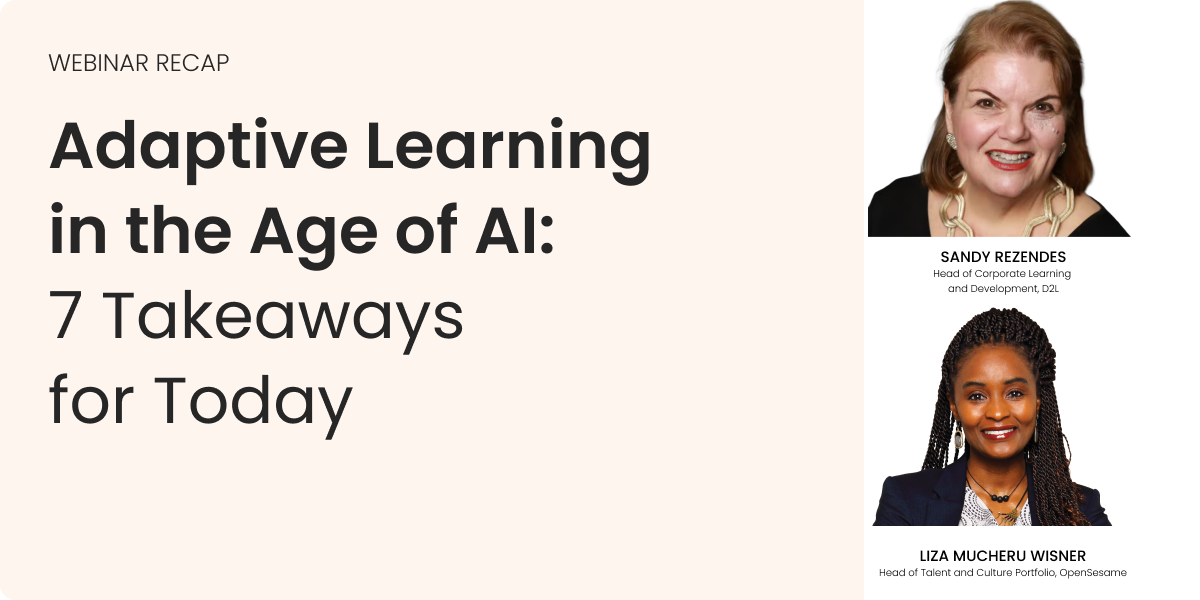
In our latest Ecosystem Experts episode, OpenSesame’s Liza Mucheru Wisner sits down with Sandy Rezendes, Head of Corporate Learning and Development at D2L, for an unfiltered conversation about how AI is transforming learning, and why the future is still deeply, unmistakably human. Check out the whole conversation here.
Here’s what we learned:
1) AI isn’t replacing us — it’s revealing us.
One of the most powerful themes in the conversation is that AI isn’t here to take over the human elements of learning. Instead, it’s exposing where our real strengths lie: judgment, curiosity, creativity, empathy, and the ability to understand context.
Sandy puts it simply: “AI helps us think better.”
For learning leaders who’ve been through multiple waves of disruption — from physical 3-ring binders to the internet to cloud-based systems — AI feels familiar in one sense. It’s a new tool with massive potential and equally massive misconceptions.
The biggest shift? Moving from teaching at scale to growing capability at scale.
2) There’s a continuous capability
In the early days of digital learning, the big innovation was getting content online. Today, the shift is much deeper: learning is no longer confined to the course; it embeds directly in the flow of work.
AI enables:
- Adaptive learning paths, tailored to each person’s needs
- Skills intelligence, connecting learning to real capability gaps
- Real-time coaching, personalized to the moment
- VR and immersive learning, giving people experience before they enter high-stakes situations
The result? Learning is becoming more like having the smartest peer you’ve ever worked with, the one who always knows the right next step. As Sandy shares, we’re finally able to support people continuously, not just in isolated bursts. And that may be the biggest unlock of all.
3) And a human side of personalization
AI can produce a ten-day itinerary for your trip to Japan in seconds (as Sandy discovered). But it can’t know why you prefer quieter neighborhoods, or what kind of experiences create lasting memories for your family. Learning works the same way.
AI can adapt, recommend, and accelerate, but humans still provide meaning, context, and connection. The blend of both is where personalization becomes transformational.
4) But we need to pay attention to early-career talent.
One of the most thought-provoking points Sandy raises is about the future of early-career development. Traditionally, entry-level employees “learned by doing” through tasks like research, drafting materials, building slide decks, and sorting data. Today, AI can complete many of those tasks in seconds.
So what happens to those foundational learning experiences?
It’s an emerging challenge and an opportunity for L&D leaders to intentionally redesign early-career pathways to include critical thinking, problem-solving, and real-world apprenticeship.
5) VR + AI are the new standard for experiential learning
Sandy shares a remarkable example from the healthcare sector: a medical device company using VR to train surgeons. Rather than waiting for observation opportunities or practice labs, surgeons enter a virtual operating room and learn hands-on, safely, repeatedly, and at scale.
The results? Dramatically faster learning. Better decision-making. And far lower risk.
This is where learning is headed: immersive, personalized, and experiential.
6) Pay attention to the skills that matter now: resilience and curiosity
Because this isn’t just another shift; it’s a moment in history when learning leaders can shape the future.
What’s Sandy’s suggested takeaway? She offers two pieces of advice that cut through the noise:
1. Stay resilient.
Change isn’t slowing down. The more adaptable you are, the more you thrive.
2. Stay curious.
Ask better questions. Experiment early. Don’t wait for permission to learn.
7) AI isn’t the threat — stagnation is
If there’s one message from this episode that every learning leader should take to heart, it’s this:
The danger isn’t AI taking our jobs. It’s doing our jobs like an AI would.
If your role is purely task-based, automation will eventually step in. But if your value comes from judgment, creativity, coaching, capability building, and designing human-centered experiences, you’re not replaceable… you’re essential.
This is our moment to lead.
Want more? Watch the full conversation
Want the full episode with all of Sandy’s insights and examples?
Watch: Adaptive Learning in the Age of AI — Building Skills, Confidence, and Human Capability
Follow Sandy’s newsletter, Signals in Learning, for guidance from a trusted leader who has helped organizations navigate multiple waves of learning innovation.
About our guests
Sandy Rezendes
Head of Corporate Learning and Development, D2L
Sandy Rezendes is a seasoned leader in talent development and corporate learning, currently serving as Head of Corporate Learning and Development at leading LMS provider D2L. She brings extensive experience from senior leadership roles at Ameriprise Financial Services, Manulife / John Hancock, Bank of America Merrill Lynch, Citizens Bank, and Fidelity Investments. Known for driving innovative learning strategies and fostering leadership growth, Sandy has helped organizations build resilient, future-ready learning cultures.
Liza Mucheru Wisner
Head of Talent & Culture Portfolio, OpenSesame
Liza Mucheru Wisner is an award-winning leader in talent development, AI, and workplace innovation. As Portfolio Lead of Talent & Workplace Culture at OpenSesame, she designs learning experiences that blend human insight with intelligent automation. A SHRM-award-winning strategist, author, and global influencer, Liza’s work helps organizations elevate learning, build stronger cultures, and prepare for the future of work.