


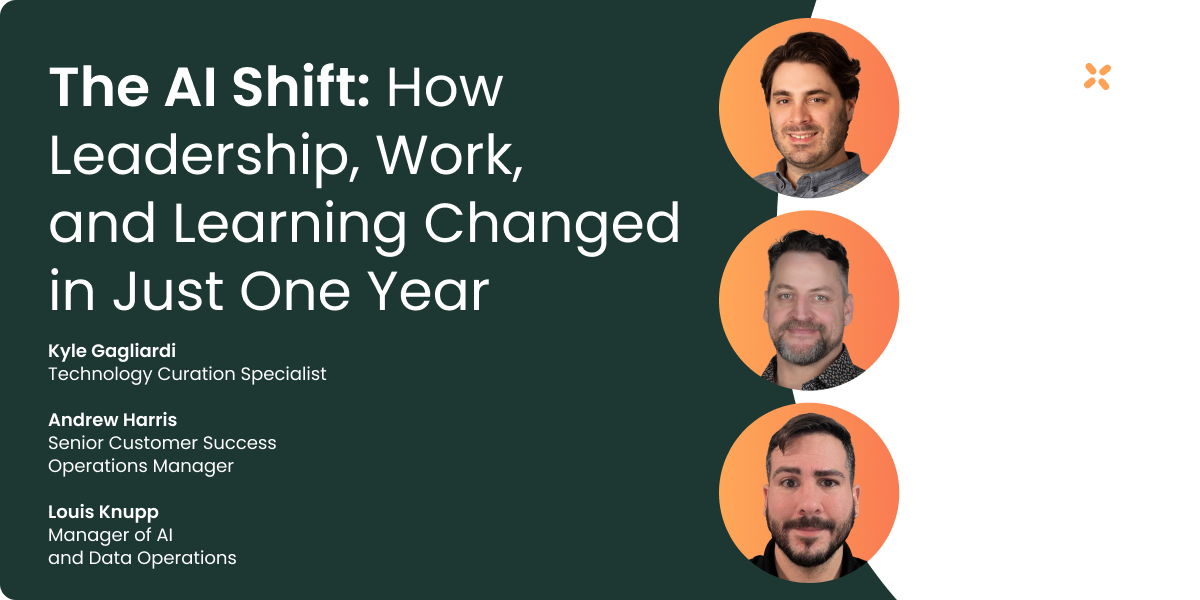
One year after our article on AI and leadership, “8 Ways You Can Use AI to Be a Better Leader & Shape an AI-Positive Culture,” we checked back in with the same experts to see what’s changed and what they’re watching on the horizon.
“A year ago, AI was primarily focused on curiosity and experimentation. Today it’s about practical adoption,” said Kyle Gagliardi, Technology Curation Specialist at OpenSesame. “Businesses are moving past the hype and starting to integrate AI into everyday work while also grappling with questions of governance, equity, and trust.”
Gagliardi said the biggest shift is that AI is no longer “something extra,” it’s a core part of how organizations reinvent and leverage their workforce, with learning at the center of that transformation.
Kyle Gagliardi, Technology Curation Specialist, OpenSesame
Q: Last year, you told us your leadership’s guidance on AI was to “go ahead and try it,” to lean into experimentation for application. How is AI making it easier for people to learn the right skills for their work today?
A: This past year has really been about demystifying AI for the workforce. Instead of theory, organizations now want practical learning paths on how to apply AI in marketing, finance, or operations. Curated, role-relevant pathways are scaling upskilling by meeting learners where they are, at their current level of expertise. At OpenSesame, we’ve seen a surge in demand for AI learning paths that give employees the confidence to use these tools responsibly and effectively.
Q: How is AI giving us a better view into what learners are actually gaining from training?
A: Traditionally, training impact was measured in completions and scores. AI is helping us move toward more dynamic and skills-focused measurement. Even at a basic level, AI enables faster insights, whether that’s surfacing trends in learner engagement, spotting emerging skills gaps, or highlighting where learning is sticking. It’s less about reinventing measurement and more about making it continuous and aligned to outcomes.
Q: How can we make sure AI tools scale in a way that’s fair and transparent for all learners?
A: The key is building trust. Learners need to know why training is being recommended, and organizations need confidence that AI suggestions aren’t reinforcing bias. That means focusing on transparency, fairness, and human oversight. When AI is implemented with these principles in mind, it becomes a tool that builds equity and trust across the workforce.
Q: Looking ahead, what AI innovations are you most excited about for training personalization or adaptive learning?
A: I’m most excited about the way AI can make learning feel more personal, accessible, and timely; not through flashy technology, but through tools helping employees find the right course at the right time. We’re leaning into this vision at OpenSesame with our upcoming AI-powered curation assistant, designed to help L&D teams cut through the noise and quickly match learning to real skills needs. That’s where AI will have the biggest impact by driving personalization at scale.
Andrew Harris, Senior Customer Success Operations Manager, OpenSesame
Q: In what ways have you used AI that you weren’t last year?
A: I’ve moved from simply using and enabling basic use of AI to using it more purposefully in our daily processes. Between ChatGPT-exclusive builds and AI-powered features within our toolset, we’ve freed up significant time for our teams, allowing them to focus less on repetitive admin work and more on helping customers and driving strategic results.
For example, we:
- Surgically place tailored GPTs that solve specific problems and keep things moving.
- Automate backend processes that reduce repetitive tasks and ensure data consistency.
- Make AI tools available and useful across teams with a single access point.
As the Operations Manager for a team of 30 CSMs, I’ve found that AI has become “meta” — I’m not just enabling others to use it, I’m using it to improve how we build and use AI itself. For example, I built a CustomGPT that actually creates other CustomGPTs. It cuts time-to-launch and reduces the delay between ideation and execution. If someone mentions a time-heavy process they wish were faster or better, I can often build a working solution in under two minutes.
We’re now at the tipping point, moving from small improvements to major shifts in how we work.
Q: Has the use of AI applications over the past year exceeded your expectations? Anything notable?
A: Yes. I continue to be surprised by how much impact we can create with small, well-placed AI tools that keep work moving. The key is to deeply understand the processes, constraints, and goals that apply.
Over the past year, we’ve shifted from an “AI everywhere” mindset to a more thoughtful one: use AI where it actually makes a difference. Not every task needs it, and not every task benefits from it.
While all of this is happening, we continue to improve AI across the business. This helps us grow our capabilities and deliver more value to both our teams and the people we support. This shift will continue to make us far more agile and resilient, with clear benefits like fewer roadblocks, quicker updates, and less stress for teams.
Q: Looking ahead—what AI innovations are you most excited about?
A: The next big leap will be around agentic AI, or in simple terms, AI that can act on its own. The ability to design, manage, and integrate AI entities that can interact with each other to handle complex, business-critical tasks in a way that feels intuitive to the average user will further democratize AI innovation. I’m particularly excited about how this might empower those outside the technical space to design and deploy sophisticated solutions that previously required a heavy technical lift. The benefit is limited by access, and I can’t wait to see what the space looks like when it has the same effect on our personal lives as it has on the business context.
Louis Knupp, Manager of AI and Data Operations, OpenSesame
Q: What shifts have you seen in workflow automation or personalized learning thanks to AI?
A: I see a big desire for increasing efficiency in workflow automation. But when used for overly simple tasks or without the right context, it backfires. The key is context management, or giving AI the correct background information to work effectively. Done right, AI can significantly reduce repetitive work. For instance, AI can review a Zendesk ticket’s history and pre-fill dropdowns, saving agents time and reducing manual input.
On the personalized learning side, AI is making tools like tutoring and adaptive content generation easier to access. OpenAI’s launch of study mode shows where things are going. Learning is becoming more tailored, responsive, and accessible to everyone in L&D.
Q: What should organizations watch out for when it comes to ethics and policy in AI-powered learning tracking?
A: Man, so this gets tricky. There are a few different categories. There are “data,” “data policy,” “data compliance,” and “data ethics.” It’s crucial that AI only accesses data for which you have permission to use. The biggest risks are around data ethics, compliance, and transparency. Organizations must ensure that AI only has access to data it’s permitted to use, and models must meet compliance standards, such as SOC 2. Using enterprise licenses is crucial to prevent exposing sensitive information, such as personally identifiable information (like PII), to models that train on user inputs.
Equally important is keeping humans in the loop. AI should support and speed up workflows, not make final decisions in business-critical or customer-facing contexts. For example, AI can pre-fill ticket fields in Zendesk, but humans should still review and approve.
Ultimately, the ethical approach is to use AI as a partner to enhance people’s work and give them time back, rather than replacing jobs. This strengthens company culture and safeguards trust.
Q: Where do you think AI will make the biggest impact next—skills mapping or delivering learning?
A: That’s tough, and to be honest, both will see major impact, but in different ways.
As for skills mapping: AI excels at grouping similar skills (e.g., “grass cutting” vs. “lawn trimming”) without needing complex, predefined rules. This has enormous value for businesses by producing richer analytics and actionable insights.
When it comes to delivering learning, from the learner’s perspective, this is the bigger deal. AI can tailor content, style, and delivery to individual needs; even generating fully customized courses. Ultimately, skills mapping drives business insights, while delivering learning will define the user experience.
Q: Looking ahead, what AI innovations are you most excited about for training personalization or adaptive learning?
A: I’m most excited about immersive, interactive AI learning environments.
With technologies like Google’s Genie 3, which blends video, audio, text, data, and real-time interactivity, we’re heading toward fully adaptive, personalized “holodeck-like” tutors. These systems could dynamically adjust to learners’ preferences and responses, creating a highly personalized and engaging training experience.