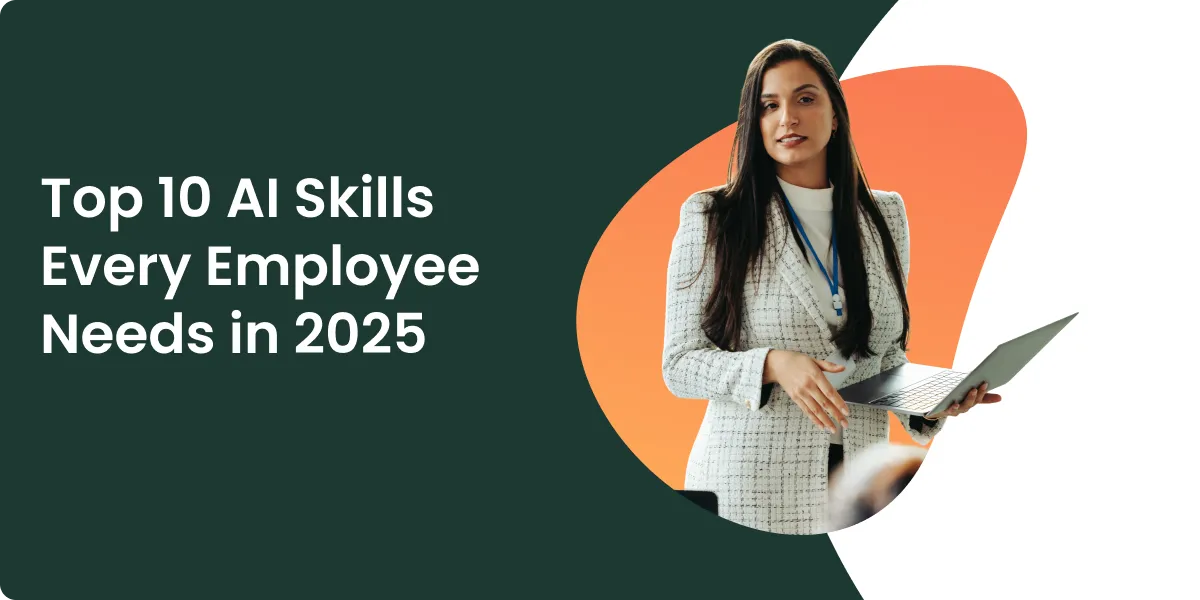

Artificial intelligence is changing how we work, and the most in-demand professionals are those who know how to work with it. From prompt engineering to critical thinking, AI skills are now essential across roles, not just in tech. Here's what every employee needs to know to stay relevant and ready.
What is an AI skill
An AI skill is any ability that enables a person to understand, use, collaborate with, or make decisions involving artificial intelligence.
They help everyday employees:
- Use AI tools effectively in their work
- Evaluate AI-generated outputs
- Collaborate with AI-enabled systems and teams
- Adapt to the rapid evolution of technology in their roles
In short, AI skills are a necessity in the workplace, not just a happy extra.
Why AI skills matter in every role
Recent research found that generative AI can improve a highly skilled worker's performance by nearly 40% compared to peers who don't use it.
Still, many employees aren't ready for the AI surge. A survey by Jobs for the Future found that more than half of workers don't feel prepared to use AI at work.
The gap is growing, and businesses can't afford to wait. Upskilling employees in essential AI competencies is no longer optional. It is a strategic investment in productivity, agility, and long-term competitiveness.
Top 10 AI skills every employee should learn
These are the top 10 AI skills your workforce needs to stay competitive in 2025 and beyond:
- Programming
- Prompt engineering
- Critical thinking
- Problem-solving
- Data analysis
- Creativity
- AI ethics and bias awareness
- Collaboration
- Communication
- Continuous learning
1. Programming
While not everyone needs to become a full-time developer, basic programming knowledge gives employees the ability to understand, adapt, and create AI-enabled tools. Python remains the most popular language for AI, thanks to its readability and vast ecosystem of machine learning libraries.
Despite recent claims that AI might automate programming entirely, industry leaders disagree.
“Some people today are discouraging others from learning programming on the grounds AI will automate it. This advice will be seen as some of the worst career advice ever given.”
— Andrew Ng, founder of DeepLearning.AI
As AI-assisted coding becomes more powerful, learning to code helps employees become not just users of AI but confident collaborators with it. Programming fluency gives teams more control, precision, and potential to drive innovation.
2. Prompt engineering
Prompt engineering is the ability to craft clear, effective instructions for AI tools like ChatGPT. This skill enables employees to generate more accurate and useful outputs across a range of tasks.
Example: Instead of typing "summarize this," a well-formed prompt would be "Summarize this article in three bullet points for a time-pressed executive."
3. Critical thinking
AI tools can produce impressive results, but they can also generate biased, misleading, or incorrect outputs. That's why critical thinking — the ability to question assumptions and validate results — is essential when working with AI.
Employees should learn to ask:
- Is this output logical and accurate?
- Could there be hidden bias in the data or prompt?
- Do I need to verify this information with another source?
As Feyaza Khan, an editor of AI training data at Toloka, noted in a Forbes interview,
“Yes, LLMs can offer amazing output. But human expertise and oversight – especially those critical thinking skills – are essential to guide AI capabilities in the right direction.”
4. Problem-solving
AI is a tool, not a solution. To apply it effectively, employees must identify real challenges, explore different approaches, and refine solutions over time. Problem-solving skills help employees identify the right challenges to tackle with AI and apply the technology in ways that deliver impact, like improving workflows, speeding up decisions, or enhancing customer experiences.
5. Data analysis
AI runs on data. Employees should understand how to read and interpret basic datasets, identify trends, and validate model outputs. This includes knowing how to:
- Clean and visualize data
- Detect anomalies or inconsistencies
- Translate data into actionable insights
6. Creativity
AI leader Kai-Fu Lee put it simply: "AI is great at optimizing, but AI cannot invent something new."
AI excels at recognizing patterns, not imagining possibilities. That's where human creativity comes in. Creative employees use AI as a tool to spark ideas, test bold hypotheses, and develop innovative solutions that would not emerge from AI alone.
7. AI ethics and bias awareness
Sometimes, AI gets it wrong. A 2023 Bloomberg analysis found that Stable Diffusion, an AI text-to-image generator, often reinforced and exaggerated racial and gender stereotypes. Instead of reflecting diverse demographics, these tools tended to replicate existing societal biases, and in some cases, made them worse.
Using AI responsibly starts with awareness. Employees need to know how bias can influence outputs and how to spot when something isn't right. This may include:
- Recognizing and challenging harmful stereotypes in generated content
- Ensuring fairness and transparency in AI-driven decisions
- Protecting data privacy and maintaining regulatory compliance
8. Collaboration
AI projects require input from technical and non-technical teams alike. Whether developing a chatbot or refining a recommendation engine, cross-functional collaboration ensures success.
9. Communication
Employees need to explain how AI tools work and why they matter confidently. Strong communication bridges the gap between teams and their stakeholders, helping integrate AI into decision-making and operations.
Some use cases include:
- Presenting insights from an AI analysis
- Writing AI tool documentation
- Explaining AI risks to leadership
10. Continuous learning
Satya Nadella, CEO of Microsoft, lives by a "learn-it-all" philosophy. In his view, someone with less innate talent but a commitment to learning will ultimately outperform someone with more natural ability who stops growing.
AI is evolving quickly. What feels cutting-edge today will be standard tomorrow. Those who embrace continuous learning through courses, certifications, keeping up with trends, or hands-on experimentation will stay ahead, adapt faster, and create more value over time.
“The person who has less, but is a learn-it-all, will ultimately [become] better.”
— Satya Nadella, CEO, Microsoft
Final thoughts: AI skills are human skills
AI is a tool that extends human potential. It does not replace people. It empowers them. By building these 10 core AI skills, employees can adapt to new technologies, drive meaningful innovation, and deliver long-term value.
Now is the time to equip your workforce to lead in an AI-powered world.
Ready to get started? Learn why AI training matters for every role and explore a learning path that prepares your team for success.
Explore the AI for Everyone toolkit
FAQs
What are AI skills?
AI skills are abilities that help people understand, use, and work alongside artificial intelligence. These include technical skills like programming and data analysis, as well as soft skills like critical thinking, creativity, and communication.
Do non-technical employees need AI skills?
Yes. Many departments use AI tools. Non-technical employees benefit from understanding how to apply AI in everyday tasks and make informed decisions with it.
How does creativity apply to AI?
Creativity helps people use AI in original and effective ways. It enables employees to generate new ideas, build prototypes, and solve problems that AI alone cannot.
Why is critical thinking important for AI use?
Critical thinking allows users to assess AI outputs for accuracy, bias, and relevance. It ensures AI is applied responsibly and effectively in real-world contexts.
How can organizations promote AI skills development?
Start with training. Offer hands-on learning, encourage experimentation, and provide learning paths tailored to each role. With OpenSesame, you can deliver AI training at scale, curated for every job function and skill level.