
7 business skills training programs that work best for technology companies
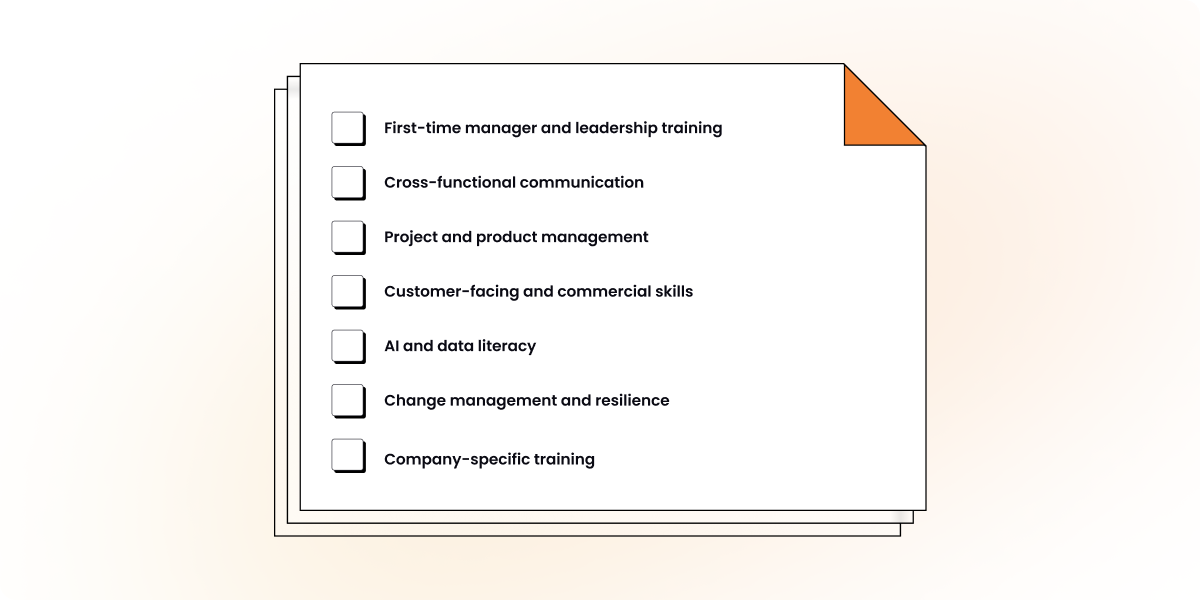
The short answer: The business skills training that works best for technology companies is practice-based, tied to a specific role and short enough to fit around a sprint. The highest-impact areas are first-time manager training, cross-functional communication, project and product management, customer-facing skills, AI and data literacy, change resilience and company-specific training built from your own expertise. OpenSesame covers these in one curated catalog, delivered through your LMS.
Technology companies hire for technical depth, then watch business skills decide who succeeds. Engineers become managers, product teams answer to sales, and roles change as quickly as the roadmap. This guide covers seven programs that fit how tech teams work, and how to deliver each one.
The 7 programs at a glance
1. First-time manager and leadership training
Tech companies often promote their strongest individual contributors into management. The skills that made someone a great engineer, analyst or designer are different from the skills needed to run one-on-ones, give feedback and handle conflict.
What to cover: delegation, feedback, performance conversations, hiring and coaching.
How OpenSesame helps: The catalog includes leadership and management courses from vetted publishers. Pair them with AI Coach, which lets new managers rehearse tough conversations in realistic scenarios, with no audience and no pressure, before they have them for real. AI Coach is available to OpenSesame Plus customers.
2. Cross-functional communication
Technical teams work with sales, finance, legal and customers. Explaining a technical trade-off to a non-technical stakeholder, writing a clear update and presenting a plan are business skills, and they’re easy to overlook until a project stalls.
What to cover: plain-language explanations, written communication, presenting and stakeholder alignment, including for distributed teams.
How OpenSesame helps: Short business skills courses fit between sprints, and AI Coach gives people a place to practice before the meeting that matters.
3. Project and product management
Delivery depends on prioritization, planning and clear ownership. Not everyone running a project has formal training, and that includes engineering leads, designers and analysts.
What to cover: planning, prioritization, risk management, agile practices and working with stakeholders.
How OpenSesame helps: Curation specialists help you map courses to roles, so a team lead gets different content than a program manager. You avoid sending everyone through the same catalog.
4. Customer-facing and commercial skills
Sales engineers, customer success managers and support teams need to explain complex products, handle objections and negotiate. These are business skills that connect directly to revenue and retention.
What to cover: consultative selling, negotiation, customer communication and difficult conversations.
How OpenSesame helps: Scenario practice with AI Coach helps customer-facing teams rehearse conversations before they happen. Business skills courses build the foundation.
5. AI and data literacy for every role
AI is changing work in every function, not only engineering. Product, marketing, HR, finance and operations teams all need a working understanding of how to use AI tools responsibly and read data well.
What to cover: AI fundamentals, responsible use, data literacy and role-specific applications.
How OpenSesame helps: The catalog includes AI readiness courses, and OpenSesame recently added 100+ Chegg Skills courses to Plus covering practical AI, data and cybersecurity. Use curation support to build role-based paths, so each team learns what applies to its work.
6. Change management and resilience
Reorganizations, pivots and rapid growth are routine in technology. Teams that handle change well keep delivering. Managers need skills for explaining change, keeping teams focused and supporting people through uncertainty.
What to cover: leading through change, communicating decisions, managing workload and building resilience.
How OpenSesame helps: Short courses give managers practical tools they can use the same week, and everything is delivered where people already learn.
7. Company-specific training built from your own expertise
Some of your most valuable training doesn’t exist in any catalog: your product knowledge, internal processes, engineering practices and customer playbooks. Off-the-shelf content teaches the standard version of a skill, and your teams work in your version.
What to cover: product training for new hires, internal tools and processes, customer playbooks and team norms.
How OpenSesame helps: Simon, OpenSesame’s AI-powered course creation tool, lets subject matter experts build custom courses in under an hour, and AI translation extends them to 70+ languages. A senior engineer or customer success lead can turn what they know into training without waiting on a production queue.
How do you choose and deliver the right training?
- Start with moments, not topics. Target the points where skills gaps hurt most: a new manager’s first 90 days, a product launch, a new AI tool rollout.
- Keep lessons short. Tech teams work in sprints. Training of a few minutes fits better than a full-day course.
- Add practice. People retain more when they rehearse. Use conversation practice for communication, feedback and customer skills.
- Deliver it where people already learn. OpenSesame connects to 100+ LMS and LXP platforms, so courses sync to your existing system without manual uploads.
- Measure outcomes. Connect training to results such as manager retention, project delivery and customer satisfaction, not only completions.
Frequently asked questions
What business skills training works best for technology companies?
Training that is practice-based, role-specific and short. The strongest areas are first-time manager and leadership training, cross-functional communication, project management, customer-facing skills, AI and data literacy and change resilience. OpenSesame offers all of these in one curated catalog.
Why do technology companies need business skills training?
Technical skill alone doesn’t carry people into management, customer work or cross-team projects. Business skills help engineers, product managers and analysts lead teams, communicate with stakeholders and deliver results.
What is the best leadership training for engineers who become managers?
Short courses on delegation, feedback and one-on-ones, paired with practice. OpenSesame’s AI Coach lets new managers rehearse difficult conversations before they have them with their teams.
How can tech companies create training specific to their own products and processes?
Use a course creation tool that lets subject matter experts build from what they know. OpenSesame’s Simon lets teams create and deploy custom courses in under an hour.
How do you deliver training to a global tech workforce?
Choose content in your employees’ languages and deliver it through the LMS they already use. OpenSesame offers courses in 70+ languages and connects to 100+ LMS platforms.
Why OpenSesame fits technology companies
OpenSesame gives tech teams one curated catalog for business skills, leadership, technology and AI readiness, delivered into your existing LMS. AI Coach adds practice, Simon builds what’s unique to your company, and a dedicated customer success manager helps align courses to your roles and goals. One contract covers it all.
Ready to build business skills training for your tech teams?
Pick the next step that fits where you are:
- See it with your own stack: Book a demo to see how curated courses, AI Coach and Simon work with your LMS.