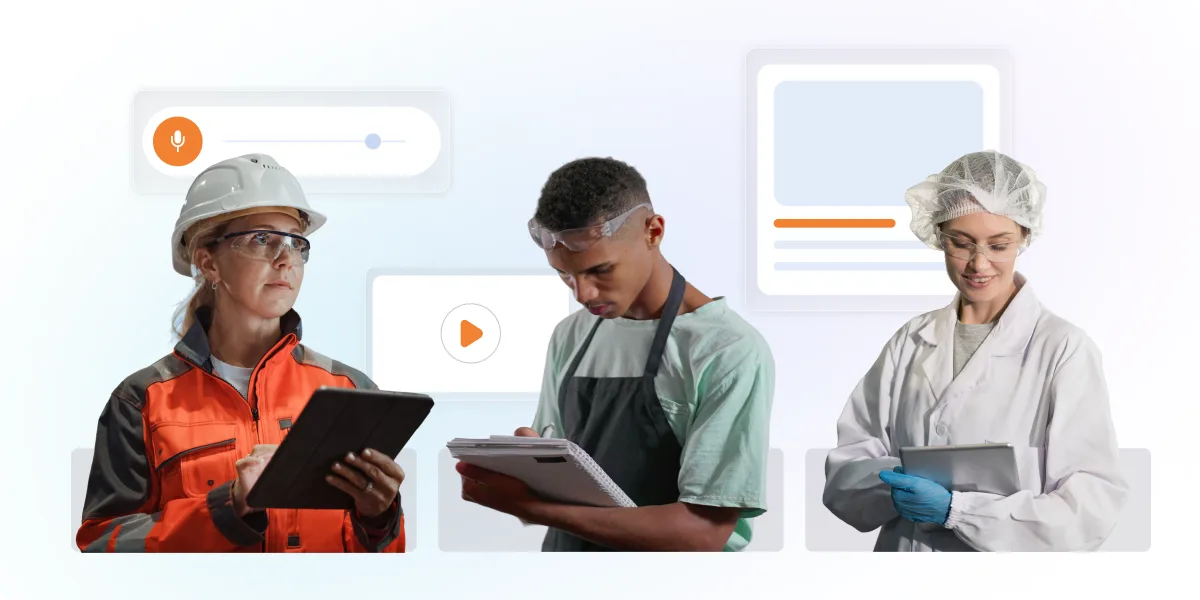

Frontline employee training prepares people who work with customers, patients, products, or equipment to do their jobs correctly and safely. These are the roles where a missed step costs the most, and where people have the least time to sit through a course built for someone at a desk.
Every frontline team is different, with its own work, schedules, and people. Five questions can help you build around any of them. Answer these before you pick a course, and the rest of the program gets easier to shape:
- What do people do on the job?
- When can they train?
- How will they reach the training?
- What language do they need?
- Who will help it stick?
Tasks: what people do on the job
Start with what people do on the job, not with a topic. "Safety" is a topic. Wiping up a spill before someone slips is a task: something a person does in the moment.
You don't have to cover every task. Start with the few that matter most in each role: where a mistake costs the most, and what comes up all day. For each one, ask: What do people need to know? What do they need to be able to do? What will they need to decide on their own? For a worked example from retail, our post on building a retail compliance program shows how to map requirements by role and location.
Schedule: when people can train
Training time comes out of work time, and work doesn't stop to make room for it. So plan for the night crew and the weekend team, not just the day shift.
Keep lessons short enough to finish between tasks. Decide when training happens: on paid time, at the start of a shift, or in a quick team huddle. If the only way to finish a course is to stay late, many people won't. For a look at how this plays out in manufacturing, read 3 shifts manufacturing teams must make to build training that actually works.
Access: how people reach the training
Many frontline employees don't have a desk, a work email address, or a computer of their own. So check how they'd log in, what device they'd use, and whether it works where they do the job. If someone can't open a lesson on a break, on the phone or device they already have, the training won't reach them.
OpenSesame courses are optimized for mobile and integrate with 70+ LMS platforms, so your employees can open training from the systems they already use.
Language: training that's right for everyone
People learn best in the language they know best, and the format matters too. Look for training that has been localized, with the on-screen text, audio, and subtitles all adapted for the learner, so a lesson feels made for them. Subtitles help on a loud floor. Audio helps when someone's hands are busy and their eyes are on the work.
OpenSesame offers courses localized in 70+ languages. If you build your own courses, you can translate them into 70+ languages without keeping a separate version for each one. Whatever you build, use simple words and the terms your teams use on the job. Then match the quiz to the lesson.
See how OpenSesame supports training a diverse, global workforce.
Supervisor: who helps training stick
Supervisors do a lot to make training work. They watch people do the task, answer questions on the spot, and help a new habit stick.
That's a lot to ask of the people holding your program together. Give them a clear job: what to watch for, what to say, and when to ask for help. Then give them the training and the time to do it.
Where practice, observation, and reinforcement fit
Digital courses are best at getting the same knowledge to everyone, on every shift. They can't do the whole job. Most frontline tasks also need rehearsal, a second set of eyes, and a reason to remember.
OpenSesame AI Coach, for example, gives learners a safe place to rehearse realistic, conversational scenarios before the moment counts. It's a good fit for conversation-heavy moments, like calming an upset customer or raising a safety concern. It won't replace a supervisor watching someone shut down a machine.
Want the full menu of formats? Walk through The Modern Learning Mix guide to see the different formats and how online training has evolved beyond video.
Can people apply what they learned?
Finishing a course doesn't prove someone can do the task. Here are four ways to find out. You won't need all four every time. Use more where a mistake would cost more.
- Ask. Right after the lesson, give people a few short "what would you do?" questions about the task.
- Watch. Have a supervisor watch the person do the task, then sign off using a short checklist of the key steps.
- Look at the results. In the weeks after training, check the signs the job already gives you: mistakes, near misses, redo work, customer complaints.
- Check again. A few weeks later, repeat the questions or the observation to see what stuck.
Six questions to bring to your next vendor call
Take these into any conversation with a training provider:
- Can we build or choose training around specific tasks for each role?
- Does it work with the log-ins and devices our people have, on every shift?
- Which languages are available for lessons and for assessments?
- Where does practice happen, and which tasks does it cover?
- How does a supervisor see progress, observe, and sign off?
- What shows us that people can do the task, beyond completion?
Grab OpenSesame's Buying Learning the Right Way guide to help steer the conversation.
Frequently asked questions
Who counts as a frontline employee?
Anyone whose job puts them in front of customers, patients, products, or equipment: retail associates, line operators, warehouse staff, drivers, nurses. If the work can't be done from a desk, build the training around frontline needs.
Is online training enough for frontline roles?
Online training works well for knowledge, like policies and procedures. For things people do with their hands or in a conversation, add practice and a supervisor's eyes. Match the method to the task and the risk.
How do we keep supervisors from being overloaded?
Give them a short checklist per task, not a whole new program. Save observation for the tasks that carry the most risk, and let digital practice and refreshers carry the rest.
Ready to build training that fits the work?
Training works for frontline teams when it fits the shift, the device, the language, and the job itself. Here's how to take the next step.
Download the Buying Learning the Right Way guide for the questions to ask, the checklists to use, and the stakeholders to bring along. It's free.
Book a demo, and we'll show you how OpenSesame helps frontline teams get critical training right.